
 United States
Toric vs Spherical Contacts: How to Know Which Lens Is Right for Your Eyes

Paul Slusher
CEO
Published May 28th, 2026
A significant proportion of patients with significant astigmatism are still being fit with spherical contact lenses, resulting in sub-par vision that they may not even realise could be sharper. If you’ve ever squinted at a street sign, noticed slight ghosting around text, or wondered why your contacts don’t seem quite as crisp as your glasses, this may explain why.
The question of toric vs spherical contacts comes down to one thing: your prescription. If you have astigmatism, the type of lens you choose directly affects how clearly you see. Yet many wearers don’t fully understand what separates these two options, or when the difference actually matters.
You’ve probably seen “CYL” and “AXIS” values on your prescription and wondered what they mean for your lens choice. Maybe you’ve heard that toric lenses are more expensive or harder to fit, and you’re unsure whether the upgrade is worth it. These are the exact questions this guide will answer.
We’ll break down what each lens type does, who they’re designed for, when toric lenses make a measurable difference in visual clarity, and how to make a confident decision with your eye care professional. One thing worth knowing upfront: modern toric lenses have improved dramatically. The old complaints about rotation, discomfort, and limited options are largely outdated. Soft toric lenses now represent a growing share of all fits and refits, and that growth reflects real improvements in design and comfort.
What Are Spherical Contact Lenses?
Spherical contact lenses have the same corrective power across the entire lens surface. They correct nearsightedness (myopia) or farsightedness (hyperopia) by bending light uniformly to focus it properly on your retina.
The term “spherical” refers to the shape of the correction, not the physical lens itself. Think of it as a single-power lens, similar to simple reading glasses or distance glasses without any astigmatism correction built in.
Spherical lenses are designed for people whose corneas are evenly curved. If your eye is shaped like a basketball (round in all directions), a spherical lens can effectively correct your vision. Light enters your eye, the lens redirects it, and the image lands sharply on your retina.
These are the most common contact lenses on the market. Their popularity makes sense: they’re typically less expensive than specialty lenses, come in the widest variety of brands and replacement schedules, and work perfectly for the large population of wearers without astigmatism.
If your prescription only shows a “sphere” or “SPH” value with no cylinder correction, spherical lenses are what you need. You can explore options across daily, weekly, and monthly replacement schedules from every major manufacturer.
What Are Toric Contact Lenses?
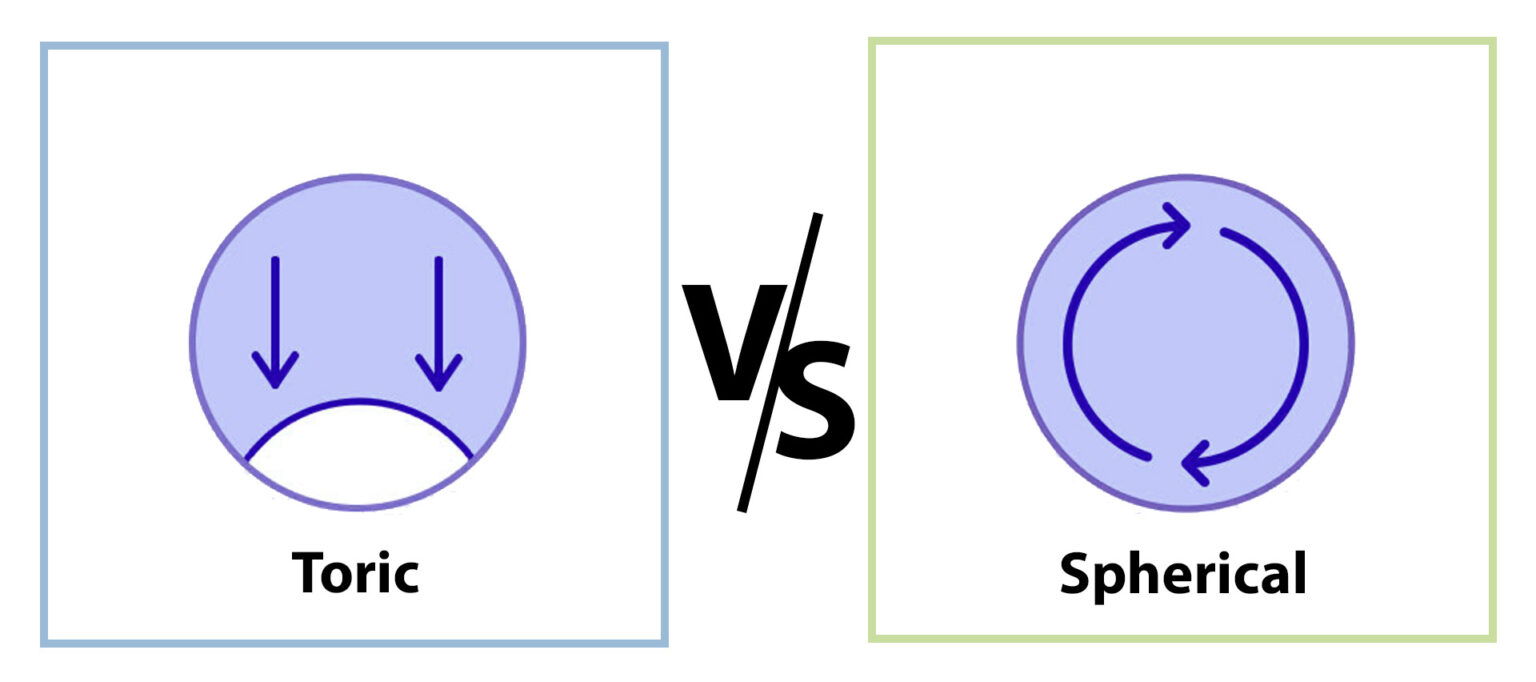
Toric contact lenses have different corrective powers in different parts of the lens. They’re specifically designed to correct astigmatism in addition to nearsightedness or farsightedness.
To understand why toric lenses exist, you need to understand astigmatism. A normal cornea is shaped like a basketball, curving evenly in all directions. An astigmatic cornea is shaped more like a football or the back of a spoon, with one meridian more curved than the other. This uneven curvature causes light to focus at multiple points instead of a single point, resulting in blurry or distorted vision at all distances.
Because toric lenses have different powers in different zones, they must maintain a specific orientation on your eye. If the lens rotates out of position, your vision blurs until it re-settles. This is why toric lenses include stabilisation features that keep them aligned with your astigmatism axis.
Modern stabilisation technologies have made toric lenses far more reliable than older designs. Systems like Blink Stabilized Design, Optimized Toric Lens Geometry, and prism ballast use the natural movement of your eyelids to keep the lens positioned correctly. These aren’t experimental features. They’re proven designs that have been refined over decades.
One important clarification: when we discuss toric lenses in this article, we’re referring specifically to soft contact lenses. Online searches often mix up contact lens torics with toric IOLs (intraocular lenses) used in cataract surgery. These are completely different products with different considerations.
Global astigmatism prevalence is approximately 40% among adults, ranging from 8% to 62% by age and region. Among children, prevalence increased from 23.4% pre-pandemic to 34.7% in 2022–2023, likely due to increased screen time. The market for toric lenses continues to grow as more people recognise that astigmatism correction is available in comfortable, convenient contact lens form.
What does “CYL” mean on your prescription?
CYL (cylinder) indicates astigmatism correction. The number represents the amount of astigmatism in diopters. AXIS indicates the angle (in degrees) where the correction is positioned. If your prescription shows CYL values, you have astigmatism and may benefit from toric lenses. No CYL value, or CYL listed as 0.00, means you don’t have astigmatism requiring correction.
You can browse our full selection of toric lenses for astigmatism to see what’s available from brands like Acuvue, Air Optix, Biofinity, and more.
Toric vs Spherical Contacts: Key Differences at a Glance
Before diving deeper into which lens is right for you, here’s a quick comparison of the fundamental differences:
| Feature | Spherical Lenses | Toric Lenses |
| Corrects | Nearsightedness or farsightedness only | Astigmatism + nearsightedness or farsightedness |
| Best for | Even corneal curvature | Irregular corneal curvature (football-shaped) |
| Lens orientation | Any position works | Must stay aligned with stabilisation design |
| Fitting process | Standard | More precise measurements required (CYL and AXIS) |
| Price | Lower | Higher (typically more per box) |
| Brand options | Widest selection | Growing selection, with all major brands offering daily, biweekly, and monthly options |
The “best” lens depends entirely on your individual prescription and eye shape. There’s no universal winner. A spherical lens is the right choice for someone without astigmatism, just as a toric lens is the right choice for someone with significant astigmatism. The goal is to match the lens to your eyes, not to pick the “better” technology.
Which Lens Is Better: Spherical or Toric?
Neither is universally “better.” The right lens depends entirely on your prescription.
If you don’t have astigmatism, spherical lenses are the correct choice. Toric lenses won’t help you see better, and you’d be paying more for features you don’t need. The stabilisation design in toric lenses serves no purpose if your cornea is evenly curved.
If you do have astigmatism, toric lenses will provide measurably sharper vision. Clinical research demonstrates that toric lenses provide a 3.5- to 5-letter improvement in visual acuity compared to spherical lenses for patients with astigmatism of 0.75D to 1.75D. That improvement is roughly equivalent to reading one additional line on a standard eye chart.
Patient preference data also support this. When individuals with astigmatism were given the choice between toric and spherical lenses after trying both, a strong majority favoured toric lenses. The difference in clarity is noticeable enough that most wearers prefer the corrected option once they experience it.
There is a “grey zone” worth discussing. For very low astigmatism (under 0.75D), spherical lenses may provide acceptable vision for many wearers. The blur from mild astigmatism is subtle, and some people function well without full correction. However, “acceptable” and “optimal” aren’t the same thing. If you’re in this range, discuss the options with your eye care professional. Some wearers find that correcting even mild astigmatism reduces eye strain during screen-heavy days.
The Main Disadvantage of Spherical Lenses (for Astigmatism)
Blurry or Inconsistent Vision
The core problem is straightforward: spherical lenses cannot correct the uneven curvature of an astigmatic cornea. They’re the wrong tool for the job.
When someone with astigmatism wears spherical lenses, their nearsightedness or farsightedness gets corrected, but the astigmatism remains uncorrected. The result is slightly blurry vision at all distances, difficulty with fine detail (reading small text, working on screens), eye strain and fatigue, and headaches after prolonged visual focus.
Many people with mild-to-moderate astigmatism adapt to this blur without realising sharper vision is possible. They assume their contacts are “good enough” because they can still see. These wearers are functioning, but they’re not seeing their best.
If you’ve ever felt like your glasses seem sharper than your contacts, uncorrected astigmatism may be the reason. Glasses can easily incorporate cylinder correction, while many wearers end up in spherical contacts by default.
When Spherical Lenses Work Fine
For people without astigmatism, spherical lenses have no disadvantage. They’re precisely the right tool for single-power correction.
For very low astigmatism (under 0.75D), many wearers find spherical lenses provide acceptable clarity. The brain can partially compensate for minor blur, especially in good lighting conditions. Some eye care professionals will recommend trying spherical lenses first in borderline cases to see if the wearer is satisfied.
The “disadvantage” only applies when there’s a mismatch between the lens type and the prescription need. Spherical lenses aren’t inferior products. They’re specialised for a specific type of correction.
The Downsides of Toric Lenses
Toric lenses do have some practical considerations worth understanding:
Higher cost: Toric lenses typically cost more than spherical equivalents. The manufacturing process is more complex, with different powers mapped to specific lens zones and stabilisation features built in.
More involved fitting: Your eye care professional needs additional measurements for cylinder power and axis. The fitting process may take longer, and finding the ideal lens may require trying a few options.
Potential rotation issues: Although modern stabilisation technology has largely solved this problem, some wearers experience occasional lens rotation. This causes temporary blur until the lens re-settles, usually within a blink or two. For most wearers with well-fit modern torics, rotation is rare.
Adaptation period: Switching from spherical to toric lenses may require a short adjustment as you get used to the stabilisation design. Most wearers adapt within a few days to a week.
Fewer options historically: Toric lenses used to have limited brand and schedule options. This has changed dramatically. Daily disposable torics are now widely available from all major manufacturers. In 2025, Johnson & Johnson even launched the first-ever daily disposable multifocal toric lens for wearers with both astigmatism and presbyopia.
Modern comfort data is encouraging. Independent research from the Academy of Optometry has shown strong end-of-day comfort results for leading toric lenses. The days of toric lenses being uncomfortable or unreliable are behind us.
Cost Comparison: Is the Price Difference Worth It?
Toric lenses cost more upfront. That’s the reality. The question is whether the additional cost delivers value that justifies the difference.
Consider the cost-benefit calculation this way: if toric lenses eliminate the need for supplementary glasses, the long-term value may exceed the extra cost. Many wearers of contacts with uncorrected astigmatism still reach for glasses when driving at night, watching movies, or working on detailed projects. If you’re already supplementing your contacts with glasses for certain tasks, you’re paying for two vision correction systems instead of one.
There are also hidden costs to “making do” with spherical lenses when you need torics. Eye strain leads to fatigue. Headaches affect productivity. Squinting through the blur isn’t comfortable. These quality-of-life factors don’t show up on a price tag, but they’re real.
Daily disposable torics have become more price-competitive in recent years as manufacturing has improved and competition has increased. Shopping online rather than at brick-and-mortar optical retailers can also significantly reduce the price gap. The difference between spherical and toric lenses is often smaller than the difference between buying at an optical store and a dedicated online retailer.
Price tip: The difference between spherical and toric lenses is often smaller than the difference between buying at an optical store vs. an online retailer. Shopping smart matters as much as lens type. Check out our guide to finding the most affordable contacts in Canada for practical strategies.
How to Know Which Lens You Need: A Quick Checklist
Your prescription is the starting point. Here’s a practical framework you can use right now:
You likely need toric lenses if:
- Your prescription includes CYL (cylinder) values of 0.75D or higher
- You experience blurry vision at multiple distances with your current contacts
- You’ve noticed ghosting, shadowing, or halos around lights
- Your eye care professional has diagnosed astigmatism
Spherical lenses are likely right for you if:
- Your prescription has no CYL value (or it’s listed as 0.00)
- Your prescription shows CYL under 0.75D, and your current vision is clear and comfortable
- Your eye care professional confirms you don’t need astigmatism correction
Talk to your eye care professional if:
- You have low astigmatism (0.50–0.75D) and aren’t sure whether toric lenses would help
- You’re switching from glasses to contacts for the first time
- You’ve been wearing spherical lenses, but suspect your vision could be sharper
The final decision should always be confirmed with your eye care professional. They can assess your specific prescription, corneal shape, tear film, and lifestyle needs to recommend the best option. Our guide on how to get contacts for first-time users walks through the entire process if you’re new to contact lenses.
The 3-1-1 Rule: What Contact Lens Wearers Should Know
The 3-1-1 rule has nothing to do with choosing between toric and spherical lenses. It’s a TSA airport security guideline about liquids, and it applies to contact lens solution, not the lenses themselves.
Here’s how it works: liquids must be in containers of 3.4 ounces (100ml) or less, all containers must fit in one quart-sized clear plastic bag, and each passenger gets one bag.
Practical travel tips for contact lens wearers:
- Pack travel-sized solution bottles. Most brands offer them, and they’re widely available at pharmacies.
- Daily disposable lenses simplify travel. No solution needed, no cleaning required, no case to pack.
- Contact lenses in sealed packaging can go in carry-on or checked luggage without restriction.
- Keep your lens case and a backup pair of glasses in your carry-on in case your checked bag is delayed.
If you travel frequently and want the simplest option, daily contacts eliminate the hassle of packing cleaning supplies entirely. Check out our comparison of daily vs monthly contacts to see which replacement schedule fits your lifestyle.
Common Pitfalls When Choosing Between Toric and Spherical Lenses
Assuming “it’s fine” when vision is slightly blurry: Many wearers with undiagnosed or undercorrected astigmatism adapt to suboptimal vision without realising sharper options exist. If you’ve never tried toric lenses, you may not know what you’re missing.
Choosing based on price alone: The cheapest lens isn’t the best value if it doesn’t correct your vision properly. A $20 savings per box means nothing if you’re squinting through your workday or supplementing with glasses anyway.
Using outdated information about toric lenses: Older toric designs did have more rotation and comfort issues. Modern stabilisation technology has addressed most of these concerns. If you tried torics years ago and didn’t like them, the current options are worth another look.
Skipping the eye exam: Your prescription may have changed, and only a current exam can confirm whether you need astigmatism correction. An up-to-date prescription ensures you’re getting the right lenses for your current eyes, not the eyes you had two years ago.
Overlooking lifestyle factors: If you spend long hours on screens, drive frequently at night, or do detail-oriented work, the visual clarity from toric lenses may matter more than it would for someone with fewer visual demands.
Conclusion: Key Takeaways
- Spherical lenses correct nearsightedness or farsightedness with uniform power across the lens. They’re the right choice for wearers without astigmatism and offer the widest brand selection at the lowest price point.
- Toric lenses correct astigmatism by varying power across different lens zones. They require stabilisation to maintain alignment and cost more, but they deliver measurably sharper vision for astigmatic wearers.
- Clinical data show toric lenses provide 3.5–5 letters of improved visual acuity compared to spherical lenses for patients with astigmatism, and a strong majority of astigmatic wearers prefer torics when given the choice.
- The “right” lens depends on your prescription. If you have no CYL value, spherical lenses are correct. If you have CYL of 0.75D or higher, toric lenses will likely improve your vision.
- Modern toric lenses have solved most historical complaints about rotation and comfort. Daily disposable torics are now available from all major manufacturers with excellent end-of-day comfort ratings.
Next Steps
Start by reviewing your current prescription. Look for CYL and AXIS values. If you see cylinder correction listed, you have astigmatism and should discuss toric lens options with your eye care professional.
If your prescription has expired or you’ve never been evaluated for astigmatism specifically, schedule a comprehensive eye exam. Many people discover mild-to-moderate astigmatism they didn’t know they had.
If you’re already wearing spherical lenses and your vision seems “good enough,” consider whether sharper could be better. Many patients with significant astigmatism are fit with spherical contact lenses and live with sub-par vision, not because better options don’t exist, but because no one has pointed them in the right direction.
Ready to find your lenses? Browse our complete selection of contact lenses with free shipping on Canadian orders. When you order from Contacts For Less, we donate a portion of every sale to the charity you choose, so your purchase does more than save you money.
Your eyes deserve lenses that match your prescription. Once you experience properly corrected vision, you won’t want to go back.
We will never sell your information to anyone.