
 United States
Contact Prescription vs Glasses Prescription: Why They’re Different and What You Need to Know

Paul Slusher
CEO
Published Jun 25th, 2026

Your glasses prescription might say -8.00D. Your contact lens box might say -7.50D. Before you assume someone made a mistake, here is what is actually happening: the gap between your glasses and your eye fundamentally changes the lens power you need. This is not an error. It is optics.
Many people who wear both glasses and contacts notice this difference and wonder why their prescriptions do not match. The confusion is understandable. You would think vision correction would be straightforward: one prescription, one set of numbers, done. But contact prescription versus glasses prescription differences exist for a specific physical reason, and understanding that reason helps you make smarter decisions about your vision care.
This article explains exactly why your prescriptions differ, when they will be the same, how conversion actually works, and why you cannot simply calculate your contact lens prescription from your glasses numbers. There is also a legal reality worth addressing upfront: professional fitting is not optional. It is required by law in both Canada and the United States.
Why Contact and Glasses Prescriptions Are Different
The Vertex Distance Factor
The core reason your contact and glasses prescriptions differ comes down to a measurement called vertex distance: the space between the back surface of a lens and the front of your cornea.
For glasses, this distance is approximately 12mm. For contact lenses, it is essentially zero, since the lens sits directly on your eye. That physical difference changes how light bends before it reaches your retina, which means the lens power must be adjusted accordingly.
The physics works like this: when a corrective lens sits closer to your eye, it needs less power to achieve the same optical correction. Move that same lens farther away, and it needs more power. This is why your glasses prescription and contact lens prescription often differ for the same person with the same underlying vision.
Eye care professionals use a vertex distance compensation formula to calculate the adjustment, expressed roughly as Fc equals F divided by (1 minus xF), where Fc is the contact lens power, F is the glasses power, and x is the vertex distance in metres. You do not need to memorise this formula, but knowing it exists helps explain why conversion is not as simple as copying numbers from one prescription to another.
Think of it like adjusting a projector. Move it closer to the screen, and adjust the focus to get a sharp image. The principle is similar to corrective lenses, where the distance from your eye affects how the lens needs to be calibrated.
Key Takeaway: The closer a lens sits to your eye, the less power it generally needs. This is physics, not a prescription error.
When Prescriptions Are the Same vs Different
Not everyone’s contact and glasses prescriptions will differ. The vertex distance effect scales with prescription strength, which creates a practical threshold:
Under +/-4.00D: Prescriptions are often identical or nearly identical. The vertex distance effect is so minimal that eye care professionals may not adjust the power at all, or the difference may be only 0.25D.
+/-4.00 to +/-6.00D: Compensation is usually needed, with small differences of 0.25 to 0.50D between your glasses and contact lens prescriptions.
Over +/-6.00D: Conversion is generally required, and differences can exceed 0.75D.
A practical example: someone with a -8.00D glasses prescription typically wears contacts in the range of -7.25 to -7.50D. That is not a weaker prescription. It is the correct power for a lens that sits directly on the cornea, rather than roughly 12mm away.
The direction of adjustment matters too, and this is where many explanations fall short. For minus (nearsighted) prescriptions, contacts generally need less power than glasses. For plus (farsighted) prescriptions, the opposite tends to be true: contacts need more power. A +6.00D glasses prescription might convert to somewhere around +6.50D in contacts.
This directional difference catches people off guard because the vertex distance effect works differently depending on whether you are correcting for nearsightedness or farsightedness.
| Glasses Power Range | Typical Contact Lens Adjustment | Notes |
| Under +/-4.00D | Usually same or within 0.25D | Vertex effect minimal |
| +/-4.00 to +/-6.00D | Expect 0.25 to 0.50D difference | Professional calculation recommended |
| Over +/-6.00D | Generally requires conversion | Difference can exceed 0.75D |
| High plus (over +4.00D) | Contacts need more power | Opposite direction from minus lenses |
How Glasses Prescriptions Convert to Contacts (and Why You Should Not Do It Yourself)
What Online Conversion Calculators Actually Do
If you have searched for how to convert a glasses prescription to contacts, you have probably found calculator tools that promise to do the math for you. These tools exist and do perform calculations, but what they can calculate is quite limited.
Online converters typically apply a basic vertex-distance compensation to your sphere power. That is it. They cannot determine your base curve (the curvature of the lens that must match your cornea), your diameter (the overall size of the lens), or how a specific lens material will behave on your eye.
Contact lenses are regulated as medical devices in both Canada and the United States, and a valid contact lens prescription requires a professional fitting, not just a power conversion.
Even a mathematically sound conversion from an online calculator can result in lenses that are uncomfortable, fit poorly, or cause damage to your cornea. Sphere power is only one component of a contact lens prescription, and arguably not the most important one for safety and comfort.
Why Professional Fitting Is Required by Law
Your glasses prescription includes sphere, cylinder (for astigmatism), and axis. What it does not include are the parameters that make contact lenses safe to wear:
Base curve (BC): This measurement indicates how curved the back surface of the lens is, and it must match your corneal curvature. A lens with the wrong base curve can slide around, feel uncomfortable, or restrict oxygen flow to your cornea.
Diameter (DIA): The overall width of the lens. Proper diameter ensures the lens centres correctly on your eye and moves appropriately when you blink.
Brand and material: Different contact lens materials have different properties. A lens that works well for one person may cause dryness or discomfort for another, even with identical prescriptions.
None of these parameters appear on your glasses prescription. They can only be determined through a professional contact lens fitting, where your eye care provider measures your corneal curvature, evaluates your tear film, and tests trial lenses on your eyes.
Using an incorrect base curve is not just uncomfortable. It can cause corneal abrasions, increase your risk of eye infections, and potentially lead to lasting vision damage. This is why the law requires professional oversight for contact lenses in a way that does not apply to glasses.
The good news is that a contact lens fitting is a straightforward appointment, and once you have your prescription, ordering online from a trusted retailer is easy and often more affordable than buying from optical chains.
Your contact lens prescription includes base curve and diameter, measurements that can only be determined through a professional fitting. These numbers do not appear on your glasses prescription.
Contact Prescription vs Glasses Prescription for Astigmatism
If you have astigmatism, the comparison gets more complicated. Astigmatism requires correction for cylinder power and axis, and toric contact lenses are specifically designed to address this.
Here is something many guides leave out: toric contacts are manufactured in limited parameters. Your glasses can be made with virtually any cylinder power in small increments, but toric contact lenses typically come in larger steps, with cylinder powers commonly available from around 0.75D to 2.25D.
This limitation matters practically. If your glasses prescription has -1.25D cylinder, your eye care professional may fit you in either -1.25D or -1.50D toric contacts, depending on what is available and what provides the best vision correction. If you are considering toric lenses, our guide to the best contact lenses for astigmatism covers the options in detail.
For high astigmatism beyond what standard toric lenses cover, options may be limited in standard product lines, and custom or specialty lenses might be necessary, which absolutely requires professional guidance.
Axis alignment adds another layer of complexity. Toric lenses must stay oriented correctly on your eye to work properly, and even a small rotation can affect visual clarity. This is why fitting toric contacts involves more trial and evaluation than fitting standard spherical lenses.
The bottom line is that you cannot accurately convert glasses prescription astigmatism values to contact lens values yourself. The limited manufacturing parameters and the importance of proper axis orientation make professional fitting essential.
Is a Glasses Prescription Stronger Than a Contacts Prescription?
This is one of the most common questions people ask when comparing their prescriptions, so it is worth answering directly.
For minus (nearsighted) prescriptions of roughly +/-4.00D or higher, your glasses prescription number will typically be higher than your contact lens number. Someone wearing -7.00D glasses may wear -6.50D or -6.75D contacts.
For plus (farsighted) prescriptions, the opposite tends to be true, with the contact lens prescription being higher than the glasses prescription.
This is not about one prescription being “stronger” in an absolute sense. Both prescriptions deliver the same optical correction to your retina. They are simply calibrated for different distances from your eye, and neither is more accurate than the other.
Can Glasses Help with Macular Degeneration?
This question comes up frequently alongside prescription comparison topics, so it deserves a clear answer.
Standard glasses cannot cure, treat, or reverse age-related macular degeneration (AMD). AMD involves damage to the retina itself, specifically the macula, which is responsible for central vision. Glasses correct how light focuses on your retina, but they cannot repair retinal tissue.
That said, glasses can help AMD patients in specific ways, including optimising remaining vision with the correct prescription for whatever healthy retinal tissue remains, and specialised low-vision aids such as magnifying glasses or prismatic lenses that can help maximise usable sight. High-powered reading glasses or magnifiers can also assist with close tasks like reading.
AMD patients generally benefit from working with a low-vision specialist in addition to their regular eye care provider, since this condition is fundamentally different from nearsightedness, farsightedness, or astigmatism, which glasses and contacts correct effectively.
AMD affects the retina, not the lens of your eye. While glasses cannot treat AMD, specialised low-vision aids can help you make the most of your remaining sight. Talk to your eye care provider about options.
Common Pitfalls When Comparing Contact and Glasses Prescriptions
Assuming prescriptions should match. For any prescription stronger than roughly +/-4.00D, they often will not, and that is entirely normal. Different numbers do not mean someone made an error.
Using online calculators as final answers. These tools provide rough estimates for sphere power only and cannot replace a professional fitting or determine base curve or diameter.
Ordering contacts based on your glasses Rx. Contact lens prescriptions require base curve and diameter, measurements that your glasses prescription simply does not include. Without these numbers, you cannot safely order contacts.
Ignoring expiration dates. Contact lens prescriptions expire, typically every one to two years, depending on your province or state, even if your vision has not changed. This reflects the need for regular eye health monitoring for contact lens wearers. Our guide on how often you need an eye exam for contacts explains the requirements.
Switching brands without refitting. Different contact lens brands have different base curves and materials, so switching from one brand to another may require a new fitting even if your prescription power stays the same.
Self-adjusting for astigmatism. Toric lens availability is limited. Your eye care professional chooses the best available option based on what is manufactured and what works for your eyes.
Before You Order Contacts Online: A Checklist
- Do you have a valid, current contact lens prescription (not just glasses)?
- Does your prescription include base curve (BC) and diameter (DIA)?
- Is the brand on your prescription available from your retailer?
- Has it been less than one to two years since your last contact lens exam?
- Are you ordering the exact parameters listed, with no substitutions?
If you can answer yes to all five questions, you are ready to order. If any answer is no, address that before purchasing. For a complete walkthrough, see our guide on how to read a contact lens prescription.
How to Get Your Contact Lens Prescription
Step 1: Book a contact lens fitting with your optometrist. This is a separate appointment from a standard glasses exam, even if they are done on the same day.
Step 2: The fitting includes measuring your corneal curvature, evaluating your tear film quality, and testing trial lenses on your eyes to determine proper fit.
Step 3: You will receive a contact lens prescription that includes sphere power, cylinder and axis (if you have astigmatism), base curve, diameter, and brand name.
Step 4: You are entitled to a copy of your prescription, and you can fill it anywhere you choose.
More shoppers are growing comfortable ordering lenses online once they have a valid prescription in hand, and once you have yours, ordering from a trusted retailer is simple. For first-time buyers, our complete guide on how to get contacts walks through every step.
Quick Reference: Contact vs Glasses Prescription Comparison
| Factor | Glasses Prescription | Contact Lens Prescription |
| Vertex distance | ~12mm from eye | Directly on cornea |
| Power adjustment needed? | Baseline | Adjusted for vertex distance (if over +/-4.00D) |
| Base curve included? | No | Yes, required |
| Diameter included? | No | Yes, required |
| Brand/material specified? | No | Yes, often required |
| Astigmatism parameters | Any cylinder/axis available | Limited to manufactured options |
| Can be used interchangeably? | No | No |
| Legal requirements | Prescription required | Prescription plus professional fitting required |
Key Takeaways
Vertex distance is the reason. Glasses sit approximately 12mm from your eye while contacts rest directly on your cornea, requiring different lens powers for the same optical correction.
The threshold matters. Prescriptions for roughly +/-4.00Dare often similar. Over that, conversion becomes necessary and differences grow more significant.
Direction depends on prescription type. Minus prescriptions generally decrease in contacts, while plus prescriptions increase.
Professional fitting is required, not optional. Base curve and diameter can only be determined through an eye exam with a contact lens fitting, which protects your eye health.
Online calculators are estimates only. They cannot replace professional fitting and provide incomplete information.
Next Steps
If you currently wear glasses and want to try contacts, schedule a contact lens fitting with your optometrist and bring your questions about lens types, wearing schedules, and what to expect during the adjustment period.
If you already have a valid contact lens prescription, verify that it includes base curve and diameter before ordering online, and check the expiration date. If you are interested in daily disposable options or need lenses for dry eyes, explore your choices before placing an order.
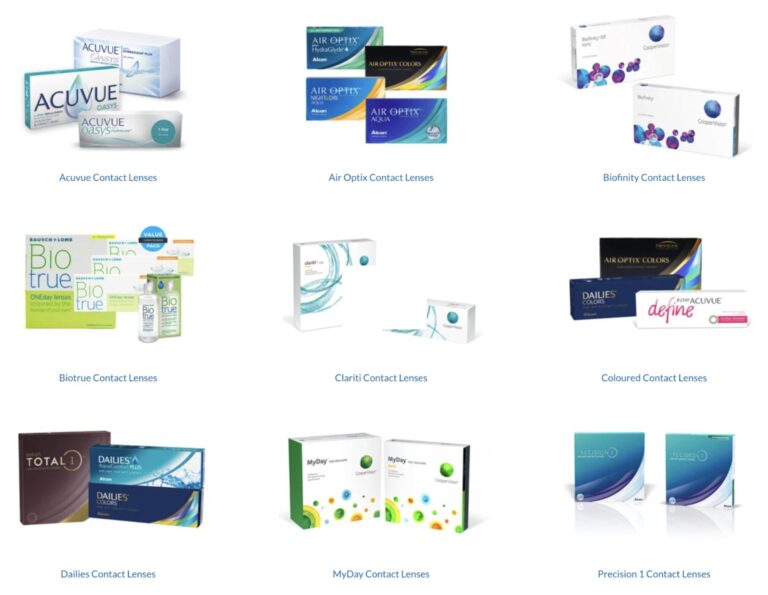
Ready to order your contact lenses? Browse our full selection of daily, biweekly, and monthly lenses from brands like Acuvue, Dailies, Biofinity, and more. As a 100% Canadian family-owned company, we donate a portion of every sale to the charity you choose.
We will never sell your information to anyone.