
 United States
Is It Safe to Buy Contact Lenses Online? What to Check Before You Order

Paul Slusher
CEO
Published Jun 3rd, 2026

Sixty percent of counterfeit contact lenses tested by the FDA were contaminated with microbes (American Academy of Ophthalmology, 2025). That single statistic explains why so many Canadians pause before clicking “add to cart” on their first online lens order. The concern is valid. But here’s the reassuring truth: buying contact lenses online from a legitimate retailer is completely safe, often more affordable, and increasingly the norm.
Is it safe to buy contacts online? Yes, when you know what to look for. The key is distinguishing authorized distributors from unauthorized sellers, understanding prescription verification requirements, and recognizing the red flags that signal a retailer you should avoid.
This guide walks you through exactly what makes an online contact lens retailer trustworthy, the warning signs that should send you elsewhere, how prescriptions work when ordering online, and how to maximize your insurance benefits. At Contacts For Less, we’re a 100% Canadian family-owned retailer and authorized distributor for all major manufacturers. We understand why trust matters, because we built our business on it.
Why Millions of People Now Buy Contact Lenses Online
Online contact lens purchasing has shifted from niche convenience to mainstream shopping behaviour. Online sales reached 39% of all contact lens purchases in Q1 2025, up from 35% in Q4 2024 (The Vision Council, 2025). More than 45 million people in the United States wear contact lenses (National Eye Institute, 2024), and a growing share of them order online rather than through brick-and-mortar optical retailers.
The drivers behind this shift are practical. Online retailers typically offer lower prices than in-office optical shops, subscription delivery models eliminate the need to remember reorders, and the product selection often exceeds what local stores carry. For Canadians specifically, online shopping removes geographic barriers for those in smaller communities who may not have convenient access to optical retailers.
But growth has also attracted counterfeit sellers and unauthorized distributors who exploit consumers looking for deals. That reality is why verification matters more than ever. The rest of this article provides practical tools for buying safely.
The Real Risks of Buying from the Wrong Seller
The FDA evaluated over 300 cosmetic contact lenses and found 60% of counterfeit lenses and 27% of unapproved lenses had microbial contamination (American Academy of Ophthalmology, 2025). These aren’t abstract laboratory findings. Microbial keratitis, a serious corneal infection, affects about 1 in 500 contact lens wearers annually (SNS Insider Market Report, 2026). The economic burden of contact lens-related microbial keratitis is estimated at $175 million annually in U.S. healthcare costs alone (PMC/NIH Research Study, 2022).
Beyond infection risk, unauthorized lenses often have product-quality issues: incorrect base-curve measurements, inconsistent optical power, poor oxygen permeability, and materials that irritate the eyes. Some unauthorized sellers ship expired lenses, store products improperly, or sell without requiring a valid prescription, which itself is a major red flag.
Nearly 1 million people in the United States experience ocular infections or inflammation annually related to contact lenses (PMC/NIH Research Study, 2022). Many of these cases are preventable with proper product sourcing and hygiene. Where you buy matters as much as how you care for your lenses.
Red Flags That Signal an Untrustworthy Retailer
Before ordering from any online contact lens seller, scan for these warning signs:
Red Flag Checklist:
❌ No prescription verification before purchase (federal law requires it)
❌ Prices that seem impossibly low compared to all other retailers
❌ No clear contact information, physical address, or customer service phone number
❌ Missing or vague return/exchange policies
❌ Products listed without manufacturer names or with generic “equivalent” branding
❌ Website lacks secure checkout (no HTTPS) or displays outdated design with broken links
❌ No verifiable reviews on third-party platforms (Trustpilot, BBB, Google)
If a retailer triggers multiple items on this list, find another option. The savings aren’t worth the risk.
How to Verify an Online Contact Lens Retailer Is Legitimate
The 6-Point Trust Verification Checklist
Use this framework to evaluate any online contact lens retailer before placing an order:
- Prescription verification requirement
Legitimate retailers must contact your eye care provider or request a copy of your valid prescription before shipping. If a site lets you order without any prescription check, that’s a compliance violation and a red flag for trust.
- Authorized distributor status
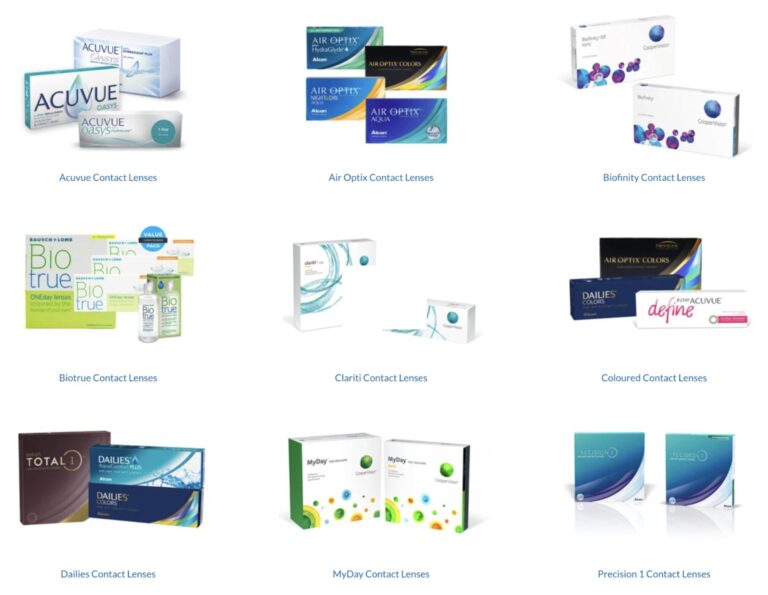
Check if the retailer is an official distributor for major manufacturers: Acuvue (Johnson & Johnson), Alcon, Bausch & Lomb, and CooperVision. Authorized distributors receive products directly from manufacturers, ensuring authenticity and proper storage.
- Physical business address and phone number
Real businesses have real locations and answer calls. A retailer that only offers email support with no verifiable address should raise concerns.
- Third-party reviews
Look for Trustpilot, BBB, or Google reviews with a substantial number of reviews. A site with 1,000+ reviews and a 4+ star rating demonstrates a track record. A site with only 10-20 reviews, or no third-party presence, hasn’t established credibility.
- Secure checkout and clear policies
The site should use HTTPS encryption, display a transparent return policy, and provide clear shipping terms. Vague or missing policies suggest the retailer may not honour commitments.
- Responsive customer service
Before ordering, try contacting them with a question. Legitimate retailers respond promptly. If you can’t get a human response before you buy, imagine trying to resolve a problem afterward.
What Federal Law Requires of Contact Lens Sellers
The FTC Contact Lens Rule establishes clear requirements: sellers must verify your prescription with your eye care provider before releasing lenses. This isn’t optional; it’s federal law in the United States.
Prescriptions are valid for the time period set by your provider, typically 1-2 years, depending on your province or state. Importantly, you have the legal right to a copy of your prescription. Your eye doctor cannot withhold it or require you to purchase lenses from their office.
Retailers who ship without verifying prescriptions are breaking the law. That violation signals broader compliance problems and should disqualify them from consideration. If you want to learn more about getting contacts or navigating the prescription process, we’ve covered that separately.
Comparing Major Online Retailers: What to Consider
When evaluating options like 1800 Contacts, Walmart Contacts online, Costco, or other retailers, apply a consistent framework rather than defaulting to brand recognition alone.
Retailer Evaluation Framework
| Factor | What to Look For | Why It Matters |
| Prescription verification | Required before shipping | Safety and legal compliance |
| Price transparency | Clear pricing before checkout | Avoid hidden fees and surprises |
| Review count and rating | 500+ reviews, 4+ stars | Trust indicator and track record |
| Return policy | Clear terms, reasonable window | Protection if lenses don’t work |
| Insurance compatibility | Accepts FSA/HSA or vision plans | Maximize your savings |
| Product selection | Carries your specific brand and Rx type | Ensures you get what you need |
The “cheapest place to buy contacts with insurance” depends entirely on your specific plan, your lens type, and each retailer’s pricing for that product. A retailer advertising the lowest price on one brand may charge more for another. Compare your specific lenses rather than assuming one retailer wins across all products.
Trust differentials matter too. A retailer with thousands of verified reviews and years of operation history carries less risk than a newer site with a limited track record, even if the newer site posts slightly lower prices.
Can You Use Insurance When Buying Contacts Online?
Many vision insurance plans cover contact lenses, but coverage varies significantly by plan and retailer. Some online retailers accept vision insurance directly during checkout. Others require you to pay upfront and submit receipts for reimbursement.
FSA (Flexible Spending Account) and HSA (Health Savings Account) funds can typically be used for contact lenses from any legitimate retailer. These accounts offer a straightforward way to pay with pre-tax dollars regardless of whether the retailer is “in-network” for your vision plan.
Check your plan’s “out-of-network” benefits before assuming you can’t use insurance with a particular retailer. Many plans offer partial reimbursement for out-of-network purchases. The total out-of-pocket cost after insurance often matters more than the sticker price.
When comparing retailers, calculate your actual cost: sticker price minus insurance reimbursement, plus shipping. That final number determines the real value, not just the advertised price. For more details on how much contacts cost in Canada and what factors affect pricing, we’ve written a separate breakdown.
Special Considerations for Specialty Lenses
Keratoconus, Sjogren’s Syndrome, and Ocular Hypertension
If you have a specialty eye condition, online contact lens purchasing comes with additional considerations that most “is it safe” articles ignore entirely.
Keratoconus: Scleral lenses and rigid gas permeable (RGP) lenses are the standard of care for keratoconus. The scleral contact lens market has grown significantly, with 67% of practitioners reporting an increase in scleral lens fittings in their practices over the past 12 months (West Broward Eyecare/Market Analysis, 2025). These lenses require professional fitting and are typically not purchased through standard online retailers without specialist involvement. If you have keratoconus, your eye care provider will likely manage your lens ordering directly.
Sjogren’s syndrome: Scleral lenses are often recommended for patients with Sjogren’s syndrome because they create a fluid reservoir that keeps the eyes hydrated throughout the day. Traditional soft contacts often cause irritation in these patients due to the severe dry-eye component of the condition. The Sjögren’s Foundation clinical practice guidelines provide additional guidance for dry eye management.
Ocular hypertension: Standard contact lenses can generally be worn by patients with ocular hypertension, but you should consult your eye doctor to confirm. Smart lenses for intraocular pressure monitoring are in development but not yet commercially available.
> Important: If you have keratoconus, Sjogren’s syndrome, or ocular hypertension, consult your eye care specialist before purchasing lenses online. Specialty lenses often require professional fitting that standard online ordering cannot replace.
For those with hard-to-fit contacts due to irregular corneas or other conditions, understanding your options before ordering prevents frustration and wasted money.
Common Pitfalls When Buying Contact Lenses Online
Even with a legitimate retailer, avoidable mistakes can cause problems:
- Ordering without a current prescription
Prescriptions expire, and your eyes can change. Always have a valid, recent prescription before ordering. If you’re unsure how often you should see an optometrist, annual exams are generally recommended for contact lens wearers.
- Choosing the cheapest option without checking legitimacy
Ultra-low prices often signal counterfeit or expired products. A $30 savings isn’t worth a corneal infection.
- Ignoring base curve and diameter
These measurements must match your prescription exactly. “Close enough” can cause discomfort, poor fit, or eye damage. Your prescription includes these numbers for a reason.
- Skipping the prescription verification step
If a retailer doesn’t ask to verify your prescription, that’s a red flag, not a convenience. Walk away.
- Not checking return policies before ordering
Unopened boxes should be returnable within a reasonable window. Know the terms before you buy, not after a problem arises.
- Assuming all online retailers are the same
Authorized distributors and counterfeit sellers can look surprisingly similar at first glance. Verify before you trust.
Quick-Reference Buying Checklist
Save or print this checklist for your next contact lens purchase:
Before You Order:
- [ ] I have a valid, current contact lens prescription
- [ ] I’ve verified the retailer requires prescription verification
- [ ] I’ve confirmed the retailer is an authorized distributor for my lens brand
- [ ] I’ve checked third-party reviews (Trustpilot, BBB, Google)
- [ ] I’ve reviewed the return and exchange policy
- [ ] I’ve compared prices, including shipping costs
- [ ] I’ve checked if my insurance or FSA/HSA can be applied
After You Order:
- [ ] Verify the packaging is sealed and from the manufacturer
- [ ] Check expiration dates on boxes
- [ ] Confirm the prescription details match what your doctor provided
Conclusion and Next Steps
Yes, buying contact lenses online is safe when you buy from a legitimate, authorized retailer that verifies prescriptions and carries manufacturer-branded products.
Key Takeaways:
- Verify prescription requirements before ordering. Retailers who skip this step are breaking the law.
- Confirm authorized distributor status for your lens brand. This ensures product authenticity.
- Check third-party reviews with a substantial number of reviews. A strong track record reduces risk.
- Review return policies before purchasing. Legitimate retailers stand behind their products.
- Specialty lens needs may require additional consultation with your eye care provider before ordering online.
Online purchasing offers genuine advantages: convenience, competitive pricing versus brick-and-mortar optical retailers, subscription options, and home delivery. The key is choosing a retailer that prioritizes your eye health as much as you do.
At Contacts For Less, we’re a 100% Canadian family-owned retailer and authorized distributor for Acuvue, Alcon, Bausch & Lomb, and CooperVision. Every order requires a valid prescription, and we donate a portion of every sale to the charity you choose.
Ready to order with confidence? Browse our full selection of contact lenses and see why thousands of Canadians trust Contacts For Less for safe, affordable lenses delivered to their door.
Your eyes deserve products you can trust, from a retailer you can verify.
We will never sell your information to anyone.