
 United States
How to Read a Contact Lens Prescription: A Complete Visual Guide

Paul Slusher
CEO
Published Jun 13th, 2026

Most contact lens wearers cannot confidently decode their own prescription when it arrives from their eye care professional. The result? Ordering errors, wasted money, and frustration at checkout.
If you have ever stared at your contact lens prescription and felt like you were reading a foreign language, you are not alone. The abbreviations (OD, OS, BC, DIA, CYL, Axis) look nothing like everyday English, and they differ significantly from what appears on a glasses prescription. This confusion becomes a real problem as online contact lens purchasing continues to grow, meaning more people than ever need to understand their prescription to order correctly.
By the end of this guide, you will understand every value on your prescription, know exactly how to avoid common ordering mistakes, and feel confident buying contacts online. We will decode each abbreviation, walk through a real prescription example, explain why glasses and contact prescriptions are not interchangeable, and cover specialty lenses for astigmatism and presbyopia.
What Is a Contact Lens Prescription?
A contact lens prescription is a medical document from your eye care professional that specifies the exact parameters needed to order lenses that fit your eyes and correct your vision. It is a precise set of measurements unique to your eyes, not a general guideline.
In both Canada and the United States, retailers are legally required to verify your prescription before dispensing contact lenses. In the U.S., this falls under the FTC Contact Lens Rule. Canadian provinces have similar regulatory requirements.
One critical point many people miss: a contact lens prescription is not the same as a glasses prescription. They contain different information and cannot be used interchangeably. A glasses prescription tells an optician how to grind lenses for frames that sit roughly 12mm from your eyes. A contact lens prescription includes fitting parameters for lenses that rest directly on your cornea.
Contact lens prescriptions typically expire after one to two years, depending on your province or state. After the expiration date, you will need a new eye exam before ordering more lenses.
Contact Lens Prescription Example: A Visual Breakdown
Here is what a typical contact lens prescription contains:
| Parameter | Right Eye (OD) | Left Eye (OS) | What It Means |
| Brand | Acuvue Oasys 1-Day | Acuvue Oasys 1-Day | Specific lens prescribed |
| PWR/SPH | -3.25 | -2.75 | Corrective power |
| BC | 8.5 | 8.5 | Base curve (lens curvature) |
| DIA | 14.3 | 14.3 | Diameter (lens width) |
Each eye is measured and recorded separately. For most people, the right and left eye have different power values. Even when the power matches, your prescription will still list both eyes individually.
The key abbreviations you will learn to recognize:
- OD and OS (which eye is which)
- PWR or SPH (your corrective power)
- BC (base curve)
- DIA (diameter)
- Brand (the specific lens you must order)
For specialty lenses, you may also see CYL and Axis (for astigmatism) or ADD (for multifocal prescriptions). Each is covered in detail below.
Understanding Each Value on Your Prescription
OD and OS: Which Eye Is Which?
These Latin abbreviations identify your right and left eyes:
- OD stands for Oculus Dexter, meaning right eye
- OS stands for Oculus Sinister, meaning left eye
- OU stands for Oculus Uterque, meaning both eyes (used when values are identical)
A helpful memory trick: think of “OD” as “O-Dexter” and picture someone who is right-handed (dexterous). Your right eye is always listed as OD on every prescription, every order form, and every contact lens box.
When ordering online, you will select the OD and OS values separately. Mixing these up is one of the most common ordering errors, so double-check that you are entering the right numbers for the right eye.
Power (PWR) or Sphere (SPH): Your Corrective Strength
This is the main number that corrects your vision. It represents the optical power of your lens, measured in diopters (D). Standard contact lenses typically range from -12.00 to +8.00 diopters.
Negative numbers (-) correct myopia (nearsightedness). If you are nearsighted, you see close objects clearly, but distant objects appear blurry. Nearsightedness is one of the most common vision conditions worldwide, making negative-power lenses the most frequently prescribed.
Positive numbers (+) correct hyperopia (farsightedness). If you are farsighted, you see distant objects more clearly, but close objects appear blurry.
A power of +0.25 indicates very mild farsightedness (hyperopia). The plus sign always indicates farsighted correction.
If your prescription shows Plano or 0.00, this means no corrective power is needed for that eye. Plano lenses are used for cosmetic coloured contacts or when only one eye requires vision correction.
Base Curve (BC): The Shape of Your Lens
The base curve measures the curvature of the lens’s back surface and how it sits on your cornea. This value is measured in millimeters and typically ranges from 8.0 to 9.0.
A base curve of 8.4mm refers to the lens’s curvature radius and is among the most commonly prescribed values. A flatter cornea requires a higher BC number, while a steeper cornea requires a lower BC. Your eye care professional determines this during a contact lens fitting; you cannot choose your own base curve.
Using the wrong base curve can cause discomfort, blurry vision, and lens slippage. If your lenses feel like they move around too much or seem too tight, the base curve may not be right for your eyes.
Diameter (DIA): Lens Width
The diameter is the width of the lens from edge to edge, measured in millimeters. For soft contact lenses, the typical range is 13.8mm to 14.5mm.
This measurement ensures the lens covers your cornea properly and stays centered on your eye. Like the base curve, the diameter is determined by your eye care professional during your fitting. Most lens brands come in a limited range of diameters, often just one standard size.
Brand Name: Why It Matters
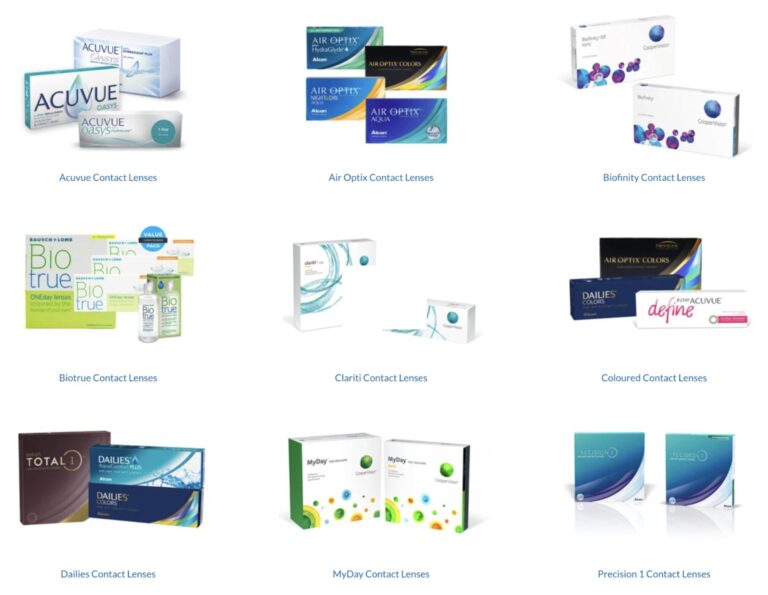
Your prescription specifies a particular brand and lens type, and this is not a suggestion. Different brands have different base curves, diameters, water content, and materials — they are not interchangeable.
For example, Acuvue Oasys and Acuvue Oasys 1-Day are different products with different wear schedules and fitting parameters. If you want to switch brands or try a new lens type, you need a new fitting and an updated prescription.
When ordering online, match the brand name exactly, including whether it is a daily, biweekly, or monthly lens.
How to Read a Contact Lens Prescription for Astigmatism (Toric Lenses)
Astigmatism prescriptions include two additional values: Cylinder (CYL) and Axis. These correct the irregular corneal curvature that causes astigmatism.
Cylinder (CYL) measures the degree of astigmatism, written in negative diopters. Common values include -0.75, -1.25, -1.75, and -2.25. The higher the number (ignoring the minus sign), the greater the astigmatism correction needed.
Axis indicates the angle of astigmatism correction, measured in degrees from 1 to 180. This tells the lens where to position the cylinder correction on your eye.
Astigmatism Prescription Example
| Parameter | Value |
| PWR/SPH | -2.50 |
| CYL | -1.25 |
| Axis | 180 |
| BC | 8.5 |
| DIA | 14.5 |
Toric lenses are weighted to stay in a specific orientation on your eye. If you have astigmatism and order standard spherical lenses instead of toric lenses, your vision will be blurry and unstable.
Toric lenses are available in daily, biweekly, and monthly replacement schedules. For a complete breakdown of options, see our guide on the best contact lenses for astigmatism.
Multifocal Prescriptions: Understanding the ADD Value
Multifocal contact lenses correct presbyopia, the age-related loss of near vision that commonly begins after age 40. Multifocal prescriptions include an ADD (Addition) value in addition to your base power, representing the extra magnifying power needed for reading and close-up tasks.
Common ADD values fall into three ranges:
- Low: +0.75 to +1.25 (early presbyopia)
- Medium: +1.50 to +1.75 (moderate presbyopia)
- High: +2.00 to +2.50 (advanced presbyopia)
Some brands use descriptive labels instead of numbers, listing lenses as “Low,” “Med,” or “High” Check your prescription to see which format your eye care professional used.
If your prescription shows an ADD value, standard single-vision lenses will not provide the near vision correction you need for reading, using your phone, or working at a computer. You need multifocal lenses.
Why Your Glasses Prescription Will Not Work for Contacts
Many people assume they can use their glasses prescription to order contact lenses. This does not work, and here is why.
Glasses sit about 12mm from your eye, while contact lenses sit directly on your cornea. This distance affects how light bends as it reaches your retina. For prescriptions greater than approximately ±4.00 diopters, the contact lens power must be adjusted to account for the difference. A glasses prescription of -5.00 might translate to a contact lens power of -4.75, and the stronger your prescription, the larger this difference becomes.
Beyond power, glasses prescriptions also lack the fitting parameters required for contact lenses:
Key Differences
| Glasses Prescription | Contact Lens Prescription |
| Corrective power only | Corrective power |
| PD for frame fitting | Base curve |
| Diameter | |
| Specific brand name |
If you currently wear glasses and want to try contacts, you need a separate contact lens fitting and prescription. Learn more in our guide to getting contacts for the first time.
What Do the Numbers on Contact Lens Packaging Mean?
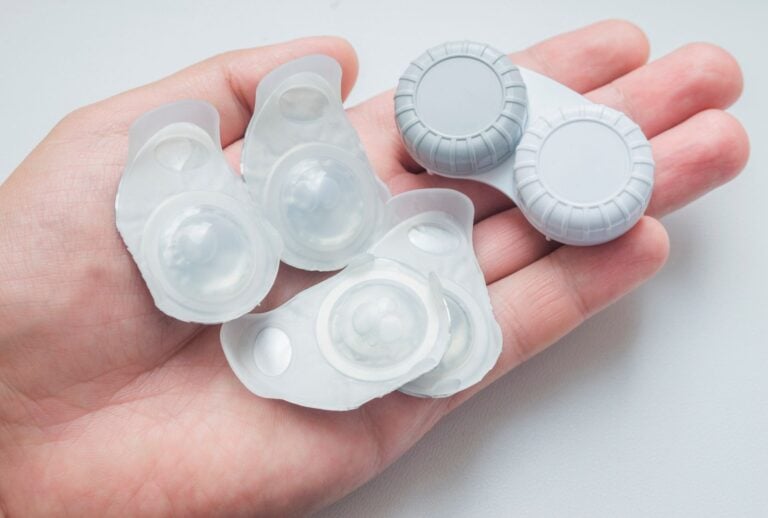
When your contacts arrive, the numbers on your box and individual blister packs should match your prescription exactly. Here is what to look for:
- PWR/D: The power or diopter value (e.g., -3.25)
- BC: Base curve (e.g., 8.5)
- DIA: Diameter (e.g., 14.3)
- Lot #: Manufacturing batch number for quality control and recalls
- EXP: Expiration date. Do not use lenses past this date
Some blister packs also show orientation markers or manufacturing reference numbers (such as “1 2 3”). These are not prescription values. They provide positioning references for the lens design, which are particularly relevant for toric lenses, where proper orientation affects visual clarity.
Before wearing any lens, verify that the power on each blister pack matches the prescription for that specific eye.
How to Order Contacts Online Using Your Prescription
Matching Your Prescription to Retailer Dropdown Menus
When you order contact lenses online, you will select values from dropdown menus for each parameter. Here is the process:
Step 1: Choose the correct brand and lens type. Match the name exactly to what appears on your prescription.
Step 2: Select your right eye (OD) values. Enter power, base curve, and diameter. If you wear toric lenses, also enter CYL and Axis.
Step 3: Select your left eye (OS) values separately. Do not assume both eyes are the same.
Step 4: Choose your quantity (number of boxes per eye).
If your exact power is not listed in the dropdown menu, do not round up or down. Contact your eye care professional for guidance.
Pre-Order Checklist
- Prescription is current (not expired)
- Brand name matches exactly
- Base curve matches prescription
- Diameter matches prescription
- Power is correct for each eye (OD and OS are often different)
- CYL and Axis entered correctly (toric lenses only)
- ADD value entered correctly (multifocal lenses only)
Can You Wear Contacts with Smart Glasses?
For contact lens wearers considering smart eyewear like Meta Ray-Bans: if your prescription falls outside the supported range for prescription smart lenses, or if you have astigmatism or need multifocal correction, you can wear your contact lenses with non-prescription smart frames. This combination gives you the smart eyewear features (camera, audio, display) without sacrificing vision correction, and tends to be the more practical solution for complex prescriptions.
Common Prescription Reading Mistakes to Avoid
- Confusing OD and OS. Entering right eye values for your left eye is one of the most common ordering errors. Always double-check which column is which before submitting.
- Using your glasses prescription. Contact lens prescriptions require fitting parameters that glasses prescriptions do not include.
- Ignoring the brand. Switching brands without a new fitting can cause discomfort and poor vision. Brands are not interchangeable.
- Rounding power values. If your prescription is -2.75, do not order -2.50 or -3.00. Order the exact value.
- Forgetting CYL and Axis for astigmatism. Ordering spherical lenses when you need toric lenses will result in blurry, unstable vision.
- Ordering with an expired prescription. Retailers are legally required to verify current prescriptions. If yours has lapsed, read our guide on getting contacts with an expired prescription.
Quick Reference: Contact Lens Prescription Terms
| Abbreviation | Full Term | What It Means |
| OD | Oculus Dexter | Right eye |
| OS | Oculus Sinister | Left eye |
| OU | Oculus Uterque | Both eyes |
| PWR / SPH | Power / Sphere | Corrective strength in diopters |
| BC | Base Curve | Lens curvature (mm) |
| DIA | Diameter | Lens width (mm) |
| CYL | Cylinder | Astigmatism correction |
| Axis | Axis | Angle of astigmatism (1-180 degrees) |
| ADD | Addition | Near vision power for multifocals |
| Plano | Plano | Zero power (no correction) |
Next Steps: Order with Confidence
Understanding your contact lens prescription means you are in control of your eye care and can order online without second-guessing every field. To recap the key points:
- Each value serves a specific purpose: power corrects vision, base curve and diameter ensure proper fit, and brand ensures compatibility
- Contact and glasses prescriptions are not interchangeable
- Astigmatism requires CYL and Axis values; presbyopia requires an ADD value
- Always verify the numbers on your lens packaging match your prescription before wearing them
- Keep a photo of your prescription on your phone for easy reference
If your prescription has expired or you want to try a different lens type, schedule an eye exam before ordering.
At Contacts For Less, our ordering process is designed to be straightforward, with dropdown menus that match standard prescription formats. Our customer service team is based in Surrey, BC, and happy to help. As a 100% Canadian family-owned company, we donate a portion of every sale to the charity you choose.
Ready to order? Browse our full selection of contact lenses and find your brand today.
We will never sell your information to anyone.